
People with neck and back pain often ask our Physios: what is the best pillow to use and is it
alright to sleep on my back?
Googling best sleep positions can bring up all sorts of confusing information. Here,
Alexander Mammone, Physiotherapist simplifies the solutions.
Should I sleep on my back?
When it comes to sleeping on your back a study by Cary and colleagues (2019) looked at
the effect of various sleep postures and the effect on spinal pain. They concluded that
cervical spine (neck) symptoms where best minimized with side sleeping while low back
symptoms where best minimized with side and back sleeping-preferably with a pillow
under the knees.. Stomach sleeping was the worst position and correlated with increased
load on the spinal tissue, reduced recovery and provoked waking spinal symptoms.

lowest tightness /activity was noted lying on your back with both hands by your side.
The majority of people are most comfortable on their side with a good,supportive pillow under their head, and sometimes with a pillow under the top leg.

But I like sleeping on my stomach! Read on…
About 20% of people sleep on their stomach and “always have”. This can be very uncomfortable for people with reduced neck range, but is no problem if you “have always done it” and is your preferred position. Sleeping prone can in fact be good for your lower back (** in short periods ), and where your mattress is supportive-eg not in a hammock
Like the exercise below
What’s the best pillow?
Again, there is lots of information on the web about this.
Most research agreed that the pillow we use while sleeping should provide good head support by maintaining a neutral spine and should also reduce the temperature of the head while sleeping. Jeon and colleagues (2014).
This study compared an orthopaedic pillow, memory foam pillow and a feather pillow and identified that the orthopaedic pillow was better at regulating head temperature after 20min of use and provided better cervical spine support than the other pillows.
Here at Willunga Physio we stock icare pillows.
As everybody is different, there are 4 different types of Pillow, Classic, Contour, Cloud and Curve.
The main difference with the Icare pillows is the ActiveX™ material. ActiveX™ is a high-grade elastic type foam that is responsive to temperature. This material will become softer as it becomes warmer. This allows the pillow to cradle the head and neck to the exact shape of the user.
Firstly the Cloud pillow is super soft yet supportive and is best for those with broad
shoulders due to it’s thickness.
Secondly the Contour pillow has a unique contour that allows clients with broader shoulder to use one side and the other side has a lower profile for those with narrower shoulders. The curve pillow has a unique curve which allows you to breath better while sleeping on your side.
Then we have the Classic pillow this traditional shape is ideal for most sleepers. It is 110mm thick and suited for clients with broad shoulders and with its medium feel this pillow is ideal for pain management and pressure redistribution.
Finally, the Curve pillow, this is recommended for back and neck pain sufferers. It has a very low profile for narrow shoulder widths. It is suitable for petite and younger users.
All these pillows also contain a gel insert for improved temperature regulation while
sleeping. Ideal if you are a hot sleeper!
So in summary this research shows that its alright to sleep on your back and this could help if you suffer from low back pain. However, if you are still finding it difficult to identify a comfortable sleeping posture than its always best to visit ask one of our physiotherapists when you are next in clinic for their advice

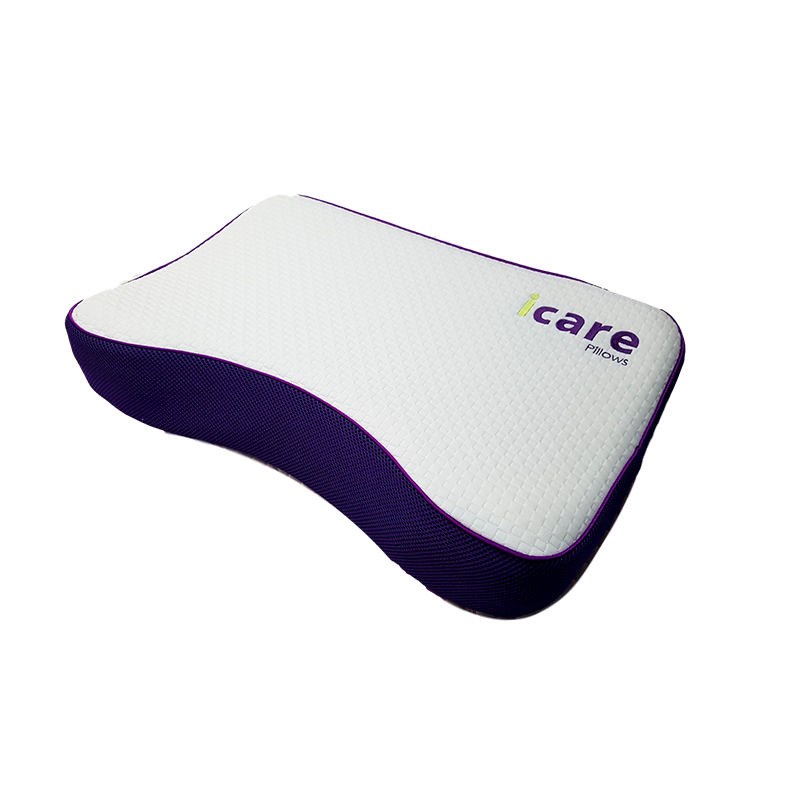
Curve pillow

Contoured pillow

Classic pillow

Cloud pillow
References:
Lee. W & Ko. M, (2017) Effect of sleep posture on neck muscle activity, The Journal of Physical Therapy Science, Vol 29, pp.1021-1024.
Cary. D, Briffa. K & McKenna. L, (2019), Identifying relationships between sleep posture and non-specific spinal symptoms in adults: A scope review, BMJ Open, Vol 9, pp. 1-6.
Jeon.M, Jeong. H, Lee. S, Choi. W, Park. J, Tak. S, Choi. D & Yim. J, (2014) Improving the quality of sleep with an optimal pillow: A randomized comparative study, Tohoku J. Exp Med, Vol 233, pp. 183-188